
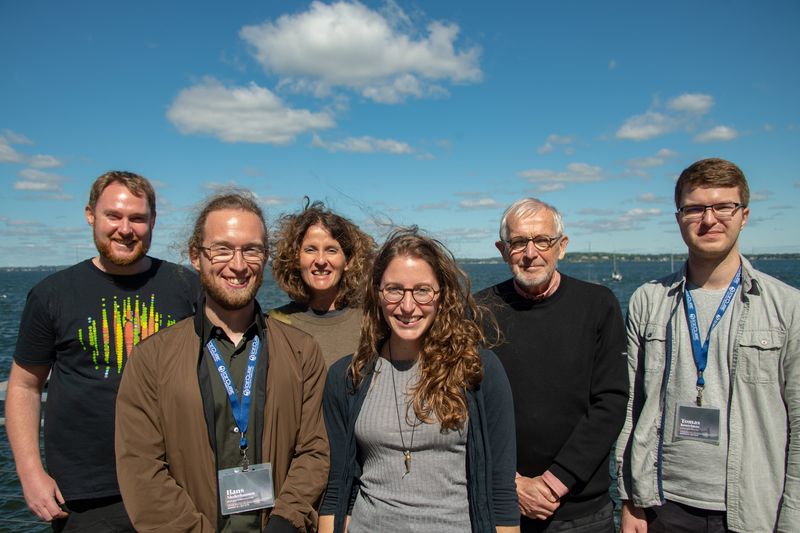
Though long since emeritus, Halzen continues to play an active role in neutrino research – including at the Technical University of Munich (TUM). As an external member of the ORIGINS Cluster of TUM and LMU, Francis Halzen conducts research with Prof. Elisa Resconi, TUM Professor of Experimental Physics with Cosmic Particles and spokesperson of the Sonderforschungsbereich 1258 Neutrinos and Dark Matter and Astro- and Particle Physics. Their work focuses on investigating the sources of cosmic neutrinos.
Halzen has been a TUM Distinguished Affiliated Professor since 2012. With this honorary title, TUM honors internationally outstanding scientists who have been leaders in developing their field and collaborate with colleagues at TUM over the long term.
A Long-Standing Partnership in Neutrino Research
A strong scientific partnership connects him with Elisa Resconi, who joined the IceCube Collaboration early on in 2001. Since Resconi arrived at TUM in 2010 and was appointed Professor in 2012, the two researchers have worked closely together and have made major contributions to the development of both neutrino astronomy and multi-messenger astrophysics. Elisa Resconi has played a leading role in advancing multi-messenger astronomy, which combines observations of neutrinos with other cosmic messengers such as electromagnetic radiation and gravitational waves.
Prof. Resconi said: “This is a great day! Francis Halzen’s wonderful personality and his courage to embrace the seemingly crazy IceCube experiment set an example for entire generations of researchers whose careers he has supported and shaped. This Nobel Prize is also recognition of the hundreds of colleagues involved in this unique research project. But he is the heart and soul of this research.”
Dr. Philipp Eller, a member of the international leadership team of the IceCube Observatory, a PI of the SFB1258 and a research group leader at the chair of Prof. Resconi, said: “There is no doubt that Francis Halzen deserves the Nobel Prize. As the founder of neutrino astronomy, he has opened a door that has given us unprecedented insights into the universe.”
Shaping the Future of Neutrino Astronomy Together
With telescopes that capture light, gamma rays, or X-rays from space, it is very difficult to study the active centers of galaxies, because clouds of cosmic dust and hot plasma absorb the radiation. Only neutrinos escape the inferno at the edge of black holes. They have virtually no mass and carry no electric charge. They travel through the cosmos almost completely unimpeded and are not deflected by electromagnetic fields, which is why they are so hard to detect.
IceCube is arguably the most extraordinary telescope in the world: its 5,160 optical sensors are frozen into the ice at the South Pole, where they register collisions between neutrinos and ice molecules. These measurements allow researchers to draw conclusions about the physical processes in which the neutrinos originated and were emitted into space.
We warmly congratulate Francis Halzen on this outstanding and thoroughly deserved achievement.
Press release on NobelPrize.org
Contact:
Prof. Dr. Elisa Resconi
Professor of Experimental Physics with Cosmic Particles
TUM School of Natural Sciences
Email: elisa.resconi(at)tum.de